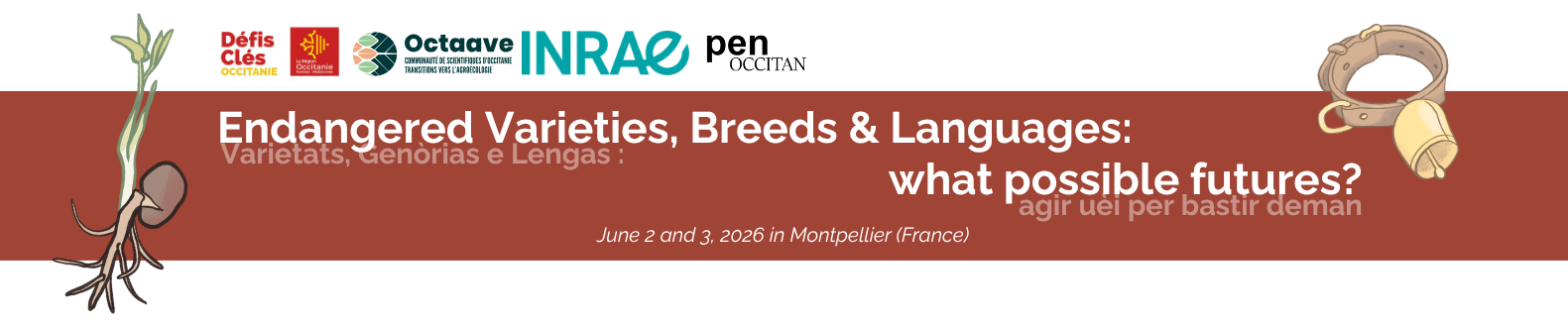

Why a seminar on agrobiodiversity and languages?
We are convinced that issues related to the preservation and promotion of their diversity must be addressed jointly and integrated into the fabric of contemporary challenges.
The erosion of agrobiodiversity is poorly understood and is rarely associated with the erosion of glossodiversity. Today, only three crops—rice, wheat, and maize—provide nearly 60% of the calories in the global human diet1.
Similarly, no fewer than 40% of the approximately 6,700 languages spoken in 2016 were threatened with extinction. This does not even account for the countless languages that have already disappeared.
Increasingly, local initiatives around the world are attempting to revive interest in so-called minor species. Their preservation raises questions about access to genetic resources, their propagation, evaluation, and valorization. A parallel can be drawn with the challenges faced by minority languages, where activists supporting the current revival are developing innovative strategies, arguing that these languages offer a different vision of the world and alternative ways of thinking compared to hegemonic languages.
During this seminar, we aim to explore the various connections between the preservation of agrobiodiversity and the preservation of glossodiversity.
Objective
This seminar aims to foster dialogue on the management and preservation of agrobiodiversity and minority languages. By bringing together linguists from the lo PEN Occitan2 association as well as researchers and farmers from the GTIO RG3 network, the presentations and workshops will encourage the exchange of perspectives and help identify connections and collaborative pathways for preserving regional and local heritage.
Find the program
Remember to register!
Call for abstracts
A report booklet combining art and science will be produced at the end of this seminar.
We aim to highlight projects related to the preservation of cultivated and/or bred genetic diversity, as well as those connected to the promotion of non-hegemonic languages. The format of submissions is open and may be creative and innovative, targeting a broad audience.
Please submit your proposals via the submission tab, here: https://seminaire-div26.sciencesconf.org/registration?forward-action=index&forward-controller=registration&lang=en
Download all informations here
For the seminar intended for professionals (June 2 and 3, 2026)
For the half-day opening to the general public (afternoon of June 2, 2026)